What changes in a family’s life when it finds a place it trusts to care for its children? That is the question we ask in Cuidar mejor nos transforma (Caring better transforms us), the interactive documentary that we at the Equipo Latinoamericano de Justicia y Género are presenting, based on the experience developed together with the Municipality of Río Grande, Tierra del Fuego.
Through testimonies, images, data and lessons learned, the project invites you to explore a concrete experience and, at the same time, to consider a question that may be useful to many other cities. What does it take for a care policy to work day to day and improve families’ lives?
Looking at a policy through the experience of families
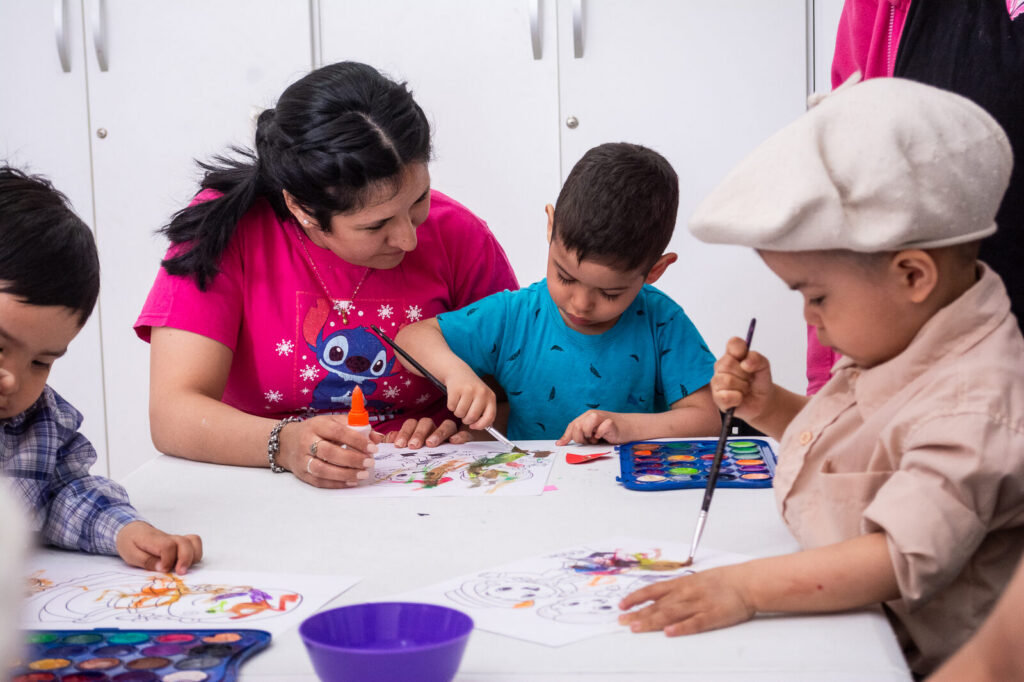
During 2025, we worked in coordination with the Secretaría de Género y Desarrollo Comunitario (Department of Gender and Community Development) of the Municipality of Río Grande to evaluate two local experiences: a permanent childcare space and “Mujeres Construyendo Futuro” (Women Building the Future), which includes a mobile childcare service as part of vocational training for women.
The aim was to understand what makes them easier or harder to use, what conditions allow them to be sustained and what changes they bring about in families’ lives. Listening to those who use, or could use, the services a policy provides made it possible to identify something fundamental: the need for care does not automatically translate into use of the available services.
From a local experience to tools for other places
Along with the documentary, we published the policy brief “Tiempo para mujeres: de lo local a las políticas transformadoras. Evaluación de experiencias de cuidado infantil en Río Grande, Argentina” (Time for women: from the local to transformative policies. An evaluation of childcare experiences in Río Grande, Argentina), which brings together the main findings of the evaluation and recommendations for strengthening local policies.
These include the need to guarantee stable, quality services, adapt what is offered to the local context, identify needs not yet met, produce information to guide decisions, strengthen trust with families and improve coordination between the different areas of the state.
We also developed the “Matriz de evaluación para estrategias de intervención en políticas de cuidados a nivel subnacional y local” (Evaluation matrix for intervention strategies in care policies at the subnational and local levels), a tool designed to support governments and other actors in designing, planning, monitoring and evaluating their own policies.
The matrix brings together the different dimensions of care, the roles the state can take on and the 5R approach (recognize, reduce, redistribute, reward and represent). Its design is flexible: it does not offer a fixed recipe, but criteria that can be adapted to the characteristics of each jurisdiction to identify progress, gaps and opportunities for improvement.
Evaluating is also transforming. It makes it possible to recognize what works, detect obstacles and turn a concrete experience into useful knowledge for making better decisions.
Caring better transforms us
Local governments have a fundamental advantage: they are close to people and know the needs of their communities firsthand. That closeness can translate into better policies when it is combined with listening, evidence and the capacity to learn from experience.
Río Grande does not offer a formula that can be reproduced exactly anywhere. It offers something perhaps more valuable: an experience that was observed, evaluated and turned into lessons and tools that can help other places find their own answers.
The project was carried out as part of the Fondo para investigaciones aplicadas y colaborativas para América Latina y el Caribe sobre Innovaciones en Políticas Públicas orientadas a la Economía del Cuidado (Fund for applied and collaborative research for Latin America and the Caribbean on public policy innovations for the care economy), coordinated by the Grupo de Análisis para el Desarrollo (GRADE) and with the support of Canada’s International Development Research Centre (IDRC), the Global Alliance for Care, the United Nations Research Institute for Social Development (UNRISD) and the Ford Foundation.