Five years ago, measuring care in a city was a bid to persuade: showing how many people need care, who provides it and through which services, so that governments would be encouraged to gather data and build a system, whether by better coordinating the services they already had for the populations that require care and/or by creating new ones. Today that bid has paid off. There are cities with care systems up and running: Bogotá, Guadalajara and Medellín, among others. The questions arising from those systems have grown: beyond why we need a care system (policies and programs organized and coordinated as a system), systematically organized data lead us to ask how the one we have is working, where its shortfalls are, whom we are not reaching and what we can improve, among other questions.
The new generation of indicator systems we are building in Cali and Nuevo León is integrated into their information systems from the outset, with the aim of helping to manage them.
Latin America: from the agenda to systems
Latin America has followed a pioneering path of its own on care. Uruguay set the milestone with its Sistema Nacional Integrado de Cuidados (National Integrated Care System), created in 2015, and other countries followed: Mexico City recognized care as a right in Article 9 of its Constitution in 2017, Bogotá created the Manzanas del Cuidado (Care Blocks) in 2020, Costa Rica approved its Política Nacional de Cuidados (National Care Policy) in 2021, and Cuba set up its Sistema Nacional para el Cuidado Integral de la Vida (National System for the Comprehensive Care of Life) in 2024 (Consejo Nuevo León, 2026).
In addition, at the regional level, the recognition of care as a right has been consolidated through converging political commitments and legal pronouncements. The Buenos Aires Commitment, adopted at the 15th Regional Conference on Women in Latin America and the Caribbean (2022), established the paradigm of the care society and recognized the right to care, to be cared for and to self-care. Building on that, the Tlatelolco Commitment, approved at the 16th Regional Conference (Mexico City, August 2025), established a decade of action, 2025–2035, to achieve substantive gender equality and the care society. This commitment recognizes care as a need, a human right, a public good and work, and prioritizes strengthening information, monitoring, evaluation and accountability systems. In parallel, the Inter-American Court of Human Rights, through Advisory Opinion OC-31/25 of June 12, 2025, requested by Argentina, recognized care as an autonomous human right. The Court grounded it in the principles of social and family co-responsibility, solidarity, equality and non-discrimination, and affirmed the obligation of States to adopt legislative and public policy measures to guarantee it in its three dimensions.
Together, these instruments provide a normative and programmatic framework that supports the creation of local care systems and the development of measurement tools for monitoring, and being accountable for, the effective guarantee of the right to care on the ground.
The first generation: measuring to persuade
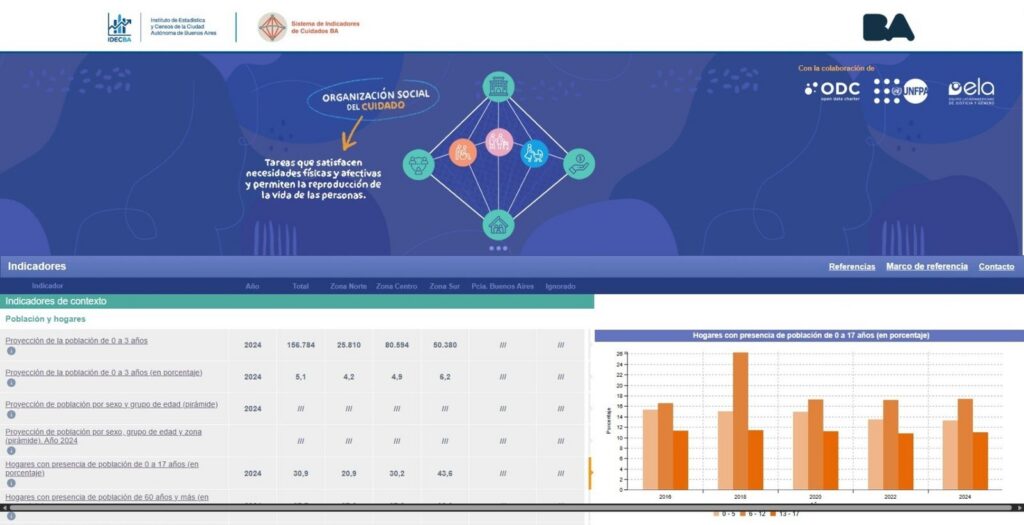
In 2020, the Instituto de Estadística y Censos de la Ciudad de Buenos Aires created the first Care Indicator System in Latin America, with support from Open Data Charter (ODC) and Canadian cooperation (IDRC) (Open Data Charter and Secretaría de las Mujeres de la Ciudad de México, 2023). It organized 75 indicators across three populations that receive care (children and adolescents; persons with disabilities; dependent older people) and three dimensions: context, demand and supply. It also proposed two key disaggregations: by sex, to gauge the unequal burden of care between women and men, and by geography, to understand socioeconomic inequalities.
In 2023, also with ODC’s support, Mexico City took up the model: it replicated 63 indicators, added 13 new ones and reached 76 (Open Data Charter and Secretaría de las Mujeres de la Ciudad de México, 2023). Its great contribution was to place caregivers throughout the system and to measure the degree of dependency of those who need care.
These systems were built mainly on household surveys, time-use surveys, health-condition surveys and population censuses. Their guiding questions were diagnostic: how much care does this city need, and who is providing it? They fulfilled their purpose. They made visible something that had gone unseen and gave the care agenda a language of evidence.
The shift: from survey data to management data
In Cali and Nuevo León, the starting point is different. Care systems, with different levels of institutionalization, are already working. Cali has the Sistema Distrital de Cuidado (SIDICU, District Care System), created by Decree 0304 of 2023 and implemented through the CuidArte strategy and its territorial Ecosistemas de Cuidado (Care Ecosystems).
In Nuevo León, care is organized through a government strategy. Following the establishment of the Comisión del Sistema Estatal de Cuidados, the Secretaría de Igualdad e Inclusión presented the “Cuidamos Nuevo León” (“We Care for Nuevo León”) strategy, which seeks to guarantee the right to care, to receive care and to self-care, and which brings together services and programs such as the Centros Comunitarios del Cuidado (Community Care Centers), the Impulso a Cuidadoras (Support for Caregivers) program, early childhood initiatives and the professionalization of caregivers (Gobierno de Nuevo León, 2024). The institutionalization of the strategy as a care system is still under construction: a constitutional reform to recognize care as a human right and a Ley del Sistema Integral de Cuidados (Comprehensive Care System Law) are currently under discussion in the state Congress (Diego, 2026). Even so, data on the services that make up the strategy are a core component of the indicator system.
That changes which data matter. Surveys remain the basis for understanding the potential demand for care, but administrative data now carry more weight: the data the system itself produces every day, such as enrollments, people served, places filled, services delivered and territories covered; in other words, the demand actually met. These data are updated more often than a survey, can be viewed by neighborhood or by district, and speak directly to what the state is doing and, at the same time, to the gaps.
Women caregivers at the center
The second change is one of focus. In Buenos Aires, attention was on those who receive care. Mexico City took the first step by adding those who provide care, based on survey data. In Cali and Nuevo León we go a step further: women caregivers are recognized as a population with rights of their own, and we also measure the services that exist for them.
It is not enough to know how many people (mainly women) provide care and how many hours they devote to it. We want to know whether they have access to training, to respite, to support for returning to employment, and whether those services reach those who need them most. We also want to know their age, their level of education, where they access services and which services they use.
The indicator system makes it possible to move from recognizing the care burden to managing it. CuidArte’s records show that almost all the people enrolled in the program are women, that more than half of those who responded devote more than eight hours a day to care work, that about a third are 60 or older, and that eight in ten did not reach upper secondary education. These data raise concrete policy questions: how to guarantee the right to self-care for those whose care work exceeds a full working day, who cares for women caregivers as they grow older, and what training and certification would strengthen their skills and economic autonomy. At the same time, measuring the hours of care that the Ecosistemas provide makes it possible to assess how much time the system gives back to caregivers, and to guide its territorial expansion.
In Nuevo León, the administrative records of state programs serve a similar function. The indicator of people benefiting from the Impulso a Cuidadoras program shows how widely financial support in recognition of care work reaches. The registries of programs for persons with disabilities and for women heads of household make it possible to identify households with a heavier care burden and less capacity to meet it. On the supply side, records of older people using day care services and of civil society organizations that provide care make it possible to gauge how much care moves outside the home and who provides it. Read together, these indicators make it possible to ask whether support reaches those who provide the most care and whether the supply of services is enough to ease their burden.
New questions, new hypotheses
As data are added, new questions arise. The first generation asked how much care is needed. The new one can ask, for example:
- Do services reach the neighborhoods where they are most needed, or the ones where they are easiest to set up?
- Who enrolls, and who is left out?
- Which services have more demand than places?
And it makes it possible to put forward hypotheses that could not be tested before, such as that access to respite services reduces caregivers’ overload, or that public provision changes the way households share care.
Answers we do not have yet
Despite these advances, in Cali’s case the system still has gaps that limit its capacity to guide care policy. Community provision, one of the pillars of the social organization of care, appears only indirectly, through the community-based forms of care provided by the Instituto Colombiano de Bienestar Familiar (ICBF). Still missing are data on the networks and organizations that provide care in neighborhoods, on community kitchens, and on the community component of the Ecosistemas de Cuidado themselves. Nor is there information on the training and certification of caregivers, paid and unpaid, or on the quality of the care provided and received.
Current indicator systems, such as those of Buenos Aires and Mexico City and the upcoming ones in Cali and Nuevo León, make it possible to gauge the demand for care, its supply and the care burden. A next generation should take the step toward measuring the capacities of those who provide care and the conditions in which care is provided, in order to answer not only how much care there is, but what that care is like and what is needed to improve it.
What comes next
Mexico City’s experience left a clear lesson: if the publication and updating of data depend on the will of the government of the day, the system ages quickly (Open Data Charter and Secretaría de las Mujeres de la Ciudad de México, 2023). Administrative data make this even more urgent. A management indicator system is only useful if it is fed constantly, and that requires rules, teams and a budget.
Care indicator systems are no longer just a tool for putting the issue on the agenda. They are part of the infrastructure of care systems. Measuring to persuade was the first step. Measuring to manage, and to be accountable to those who provide care, is the step we are taking now.
Sources
- Alcaldía de Santiago de Cali, Secretaría de Bienestar Social (2025). Actualización Bases Técnicas Sistema Distrital de Cuidado de Cali – CuidArte.
- Alcaldía de Santiago de Cali and Open Data Charter (2026). CuidArte – ODC: análisis de indicadores y fuentes [working dataset; anonymized record of CuidArte enrollments, March 2024 to May 2026].
- Consejo Nuevo León para la Planeación Estratégica (2026). Marco conceptual de cuidados. https://conl.mx/proyectos/un-kit-de-cuidados-para-llevar-de-idea-a-implementacion/
- Corte Interamericana de Derechos Humanos (2025). El contenido y el alcance del derecho al cuidado y su interrelación con otros derechos. Advisory Opinion OC-31/25 of June 12, 2025. Series A No. 31.
- Diego, B. (2026, September 17). Derecho al cuidado en Nuevo León: una ruta en construcción. Nexos. https://federalismo.nexos.com.mx/derecho-al-cuidado-en-nuevo-leon-una-ruta-en-construccion/
- Gobierno de Nuevo León, Secretaría de Igualdad e Inclusión (2024, November 28). Gobierno de Nuevo León presenta estrategia para el Sistema Integral de Cuidados (Press release CP/2657/2024).
- Open Data Charter (2026, May 14). Datos para cuidar: fortaleciendo la gobernanza de los cuidados en América Latina. https://opendatacharter.medium.com/datos-para-cuidar-fortaleciendo-la-gobernanza-de-los-cuidados-en-am%C3%A9rica-latina-b790bd6e5bb1
- Open Data Charter (n.d.). Guía de Apertura de Datos para los Cuidados. https://open-data-charter.gitbook.io/guia-de-apertura-de-indicadores-de-cuidados
- Open Data Charter and Secretaría de las Mujeres de la Ciudad de México (2023). Midiendo la oferta y demanda de los cuidados en la Ciudad de México. Un proyecto colaborativo para la construcción de un Sistema de Indicadores de Cuidado en la Ciudad de México. Prepared under IDRC’s Care Economy Partnerships 4 Change initiative.
- Sistema de Indicadores de Cuidado de la Ciudad de Buenos Aires (SICCABA). https://www.estadisticaciudad.gob.ar/si/cuidados/principal
- Sistema de Indicadores de Cuidados de la Ciudad de México (SICCDMX). https://indicadoresdegenero.semujeres.cdmx.gob.mx/indicadores/indicadores-de-cuidados