At the end of August, Argentina saw the launch of the Acuerdo Nacional por los Cuidados (National Agreement for Care), a 13-point proposal that seeks to place a simple and urgent idea at the center of public debate: sustaining life is a collective task, and care must be recognized as a right and a shared social responsibility.
INSIDE THE AGREEMENT’S KITCHEN
Care is not an easy subject for feminisms, especially when it comes to putting care on the public agenda, and even more so on government agendas. Sometimes it has to be explained from scratch.
After Javier Milei took office at the end of 2023 and introduced his first cuts and austerity policies, a group of organizations that had been working on care for many years came together in an intersectoral roundtable coordinated by the Centro de Estudios Legales y Sociales (Cels). La cocina de los cuidados (the care kitchen) set itself the goals of defending the rights won in the field of care and, at the same time, tracking how public policies evolved through a monitor. In a little over two years, the monitor’s data showed that, of 50 existing care policies, only two were still standing, and this affected millions of people.
La cocina de los cuidados published its findings and spoke out. But there came a point when speaking out had to turn into action. That gave rise to the campaign for the Acuerdo Nacional por los Cuidados, which is a denunciation, a proposal and a program.
A PROPOSAL TO TRANSFORM THE SOCIAL ORGANIZATION OF CARE
The aim of the Agreement, explains Virginia Franganillo, one of the coordinators of the Cocina de los cuidados, is to show that Argentina must find a way out of the humanitarian crisis that children, older people and young people are going through as a result of the policies being applied, “but also to show care not as a sum of sectoral policies, but as a social organization that, with public policies, can be fairer: one that creates jobs and reduces social inequalities, poverty and extreme poverty.”
The first of the Agreement’s 13 points is titled “The future is built today” and describes what that desirable future looks like: one in which care stops being a privilege and becomes a shared responsibility. Guaranteeing care means understanding that there is co-responsibility across sectors.
Next come several points focused on guaranteeing the care rights of specific groups (children, adolescents, older people, persons with disabilities, care workers, community caregivers) and others on co-responsibility, redistribution, planning and the allocation of resources to care, all addressed to “a State that ensures universal access to care.”
The closing point is a call to build a fairer society through care, because “a society that cares is a better society.”
It is an intersectoral and intergenerational consensus. In one month, the agreement gathered 800 endorsements from human rights organizations, trade unions, national universities, social organizations and more than 50 municipalities, where draft ordinances were introduced to create local care systems.
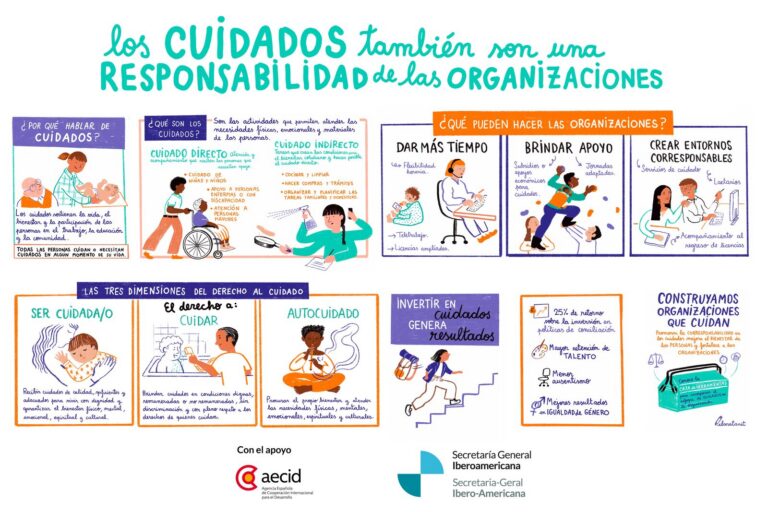
“It is a project for the country,” says Lucía de la Vega, head of the feminist agenda at Cels and in charge of the Cocina de los cuidados. She explains that the 13 points are a proposal for transformative reconstruction, “because we are committed to transforming the social organization of care: we argue for co-responsibility among the State, the market, families and the community.” One of the Agreement’s core ideas is a relational understanding of care, and within that web, care in local communities holds a central place: “we are committed to building the social fabric hand in hand with social and community organizations.”
COMMUNITY CARE: THE SEED OF A DIFFERENT SOCIAL PARADIGM
Community care organizations were part of the proposal from the start. They gave a picture of how local communities were changing as the State withdrew from care.
Norma Morales, a leader of Barrios de Pie, explains that working-class neighborhoods are experiencing a strong devaluation and demonization of care work today, as a result of persecution by the national government. “We need to build a mechanism to give care its due value,” she proposes. “We community caregivers dream of a country where care is not seen as a sacrifice. I want to care for my country; we want to care.” That is why one of the agreement’s points proposes the registration, formalization and payment of community workers.
If we think of care as a way of relating to one another that must be conceived outside the logic of the market, “there is a seed in community care that can mark a different social paradigm,” says Norma Sanchís, director of the Asociación Lola Mora and a member of the Cocina de los cuidados. “It can help us think of a circulation of care that is centered neither on the State nor on the family; a society where everyone cares for one another, paying special attention to the most pressing needs.”
A PROPOSAL FOR ALL OF SOCIETY
For economist Lucía Cirmi, coordinator of the Cocina de los cuidados monitor, public policies did not cover all care in Argentina three years ago either. “In reality, care is handled by families, specifically by women: a mother is alone raising her children until they are 3, it all falls on women.”
The campaign also aims to bring into public debate the unequal distribution of care work between genders, something that has never been easy for feminisms.
It is hard to talk about care, because it still has to be explained, Cirmi argues. On top of that, the biggest barrier to talking about it is indifference, which comes from the fact that, since care is a need, someone will take care of it, with or without public policies, with or without money: “as long as nothing changes, we women keep on caring.”
Yet there may be an opportunity in a phenomenon that much of society regards as catastrophic: the demographic transition brought about by the falling birth rate and rising life expectancy. It is a good thing that the issue is in the media, and suddenly people who did not care about it are asking who will take care of them in the future. “And if families are changing,” Cirmi asks, “is the family still the place where care will happen, or does it need to be reorganized another way? I think this is an opportunity to present a proposal for reorganizing care in this new society.”
The Agreement also presents itself as a program for the future of social policy, which is also in crisis, one that could create more than 1,500,000 jobs linked to the world of care, a sector in which 3,400,000 people work today.
That is why it is a proposal for all of society (and not only for the feminist agenda), one that speaks about how care is organized, but also about the distribution of wealth. “And above all,” says Cirmi, “it brings to light what care exposes: that we are all interdependent. In this world of collective loneliness, national and popular feminisms are here to say that there is a collective project of caring as a community.”
The Acuerdo Nacional por los Cuidados can be downloaded here.
The form to sign on is here.